
Reza Sangari Abiz
Portrait of Reza Sangari Abiz

Reza Sangari Abiz

AI Researcher | Soft Computing & Scientific Machine Learning

I develop hybrid metaheuristic methods and physics-informed neural networks for nonlinear partial differential equations.

About

Now: Independent Researcher (Nov 2026 – Present)
Previously: M.Sc., Damghan University (2026)

I am an AI researcher working on soft computing and scientific machine learning. I completed my M.Sc. in Soft Computing and Artificial Intelligence at Damghan University in 2026 (Excellent, GPA 17.49/20), following a B.Sc. in Computer Science at Birjand University of Technology (2019–2023).

My work combines hybrid metaheuristic optimization (MFO–BOA) with B-spline collocation for nonlinear PDEs, and physics-informed neural networks for stiff reaction–diffusion systems. I also work on Persian lip-reading. I am an independent researcher and a member of IAENG (#588946).

Recent updates

  • 14 Nov 2026 Released MFO–BOA–PDE–Solver v1.1.5 with Zenodo DOI: 10.5281/zenodo.24222698.
  • Nov 2026 Admitted as Member #588946 of the International Association of Engineers (IAENG).
  • Oct 2026 Review paper on AI & ML in Nanotechnology submitted to NCWNN7 for oral presentation — decision pending.
  • Target 14 Feb 2027 Preparing submission on PINN fitness-selection reliability for the First International Interdisciplinary Sciences Congress (MedLife 2027, Tehran).

Career timeline

  1. 2019–2023 B.Sc. in Computer Science, Birjand University of Technology
  2. 2026 M.Sc. in Soft Computing & AI, Damghan University (Excellent, GPA 17.49/20)
  3. Nov 2026 – Present Independent Researcher

Research interests

Metaheuristic optimization for scientific computing

Hybrid moth-flame and butterfly optimization (MFO–BOA) for tuning numerical solvers and neural-network configurations.

Outputs: MFO–BOA article (Submitted Oct 2026) · MFO–BOA–PDE–Solver

Physics-informed neural networks

PINNs for stiff reaction–diffusion systems, and diagnosing when fitness-based configuration selection can be trusted.

Output: MedLife 2027 paper (In preparation)

Numerical methods for PDEs

B-spline collocation for nonlinear partial differential equations, benchmarked against classical finite-difference and finite-element methods.

Outputs: Thesis benchmarks (Burgers mean RMSE 2.8×10⁻⁴) · Collocation study

Publications

Submitted

  1. A Hybrid Metaheuristic Algorithm (MFO–BOA) for Numerical Solution of Nonlinear Partial Differential Equations with Engineering Applications

    Dr. Reza Pourgholi, Dr. Sajjad Rahmani, Dr. Saedeh Foadian, Reza Sangari Abiz · Journal of Mathematical Research · Code

    M.Sc. thesis work: a hybrid MFO–BOA solver with B-spline collocation for nonlinear PDEs, benchmarked against classical methods.

  2. Artificial Intelligence and Machine Learning in Nanotechnology: A Selective Critical Narrative Review with Evidence-Type Stratification Oral presentation · NCWNN7 · icnn2026-00630036

    Reza Sangari Abiz, Pooria Salehi Siuki · NCWNN7 conference · Conference website

    Selective critical review of AI and machine learning in nanotechnology, organised by type of evidence.

In preparation

  1. Diagnosing Fitness-Selection Reliability in Metaheuristic Optimization of Physics-Informed Neural Networks for Stiff Reaction–Diffusion Systems: A Selected-Configuration (B1) Diagnostic Against the Corrected Baseline In preparation · MedLife 2027

    Reza Sangari Abiz, Pooria Salehi Siuki · First International Interdisciplinary Sciences Congress (MedLife 2027), Tehran, February 2027 · Congress website

    Diagnostic study of when fitness-based selection of PINN configurations optimized by hybrid MFO–BOA can be trusted for stiff reaction–diffusion systems.

Featured projects

Current focus: When can you trust fitness-based selection of PINN configurations? The question behind the MedLife 2027 paper (in preparation, target 14 Feb 2027).

Open-source software

MFO–BOA–PDE–Solver

Hybrid Moth-Flame Optimization (MFO) + Butterfly Optimization Algorithm (BOA) with B-spline collocation for nonlinear PDEs. M.Sc. thesis implementation, Damghan University (2026).

Thesis benchmarks (30 runs, mean RMSE): heat equation 3.2×10⁻⁵; Burgers’ equation 2.8×10⁻⁴ — about 62% lower than MFO and 69% lower than BOA; diffusion equation 3.9×10⁻⁴ (M.Sc. thesis; baselines in the repository README).
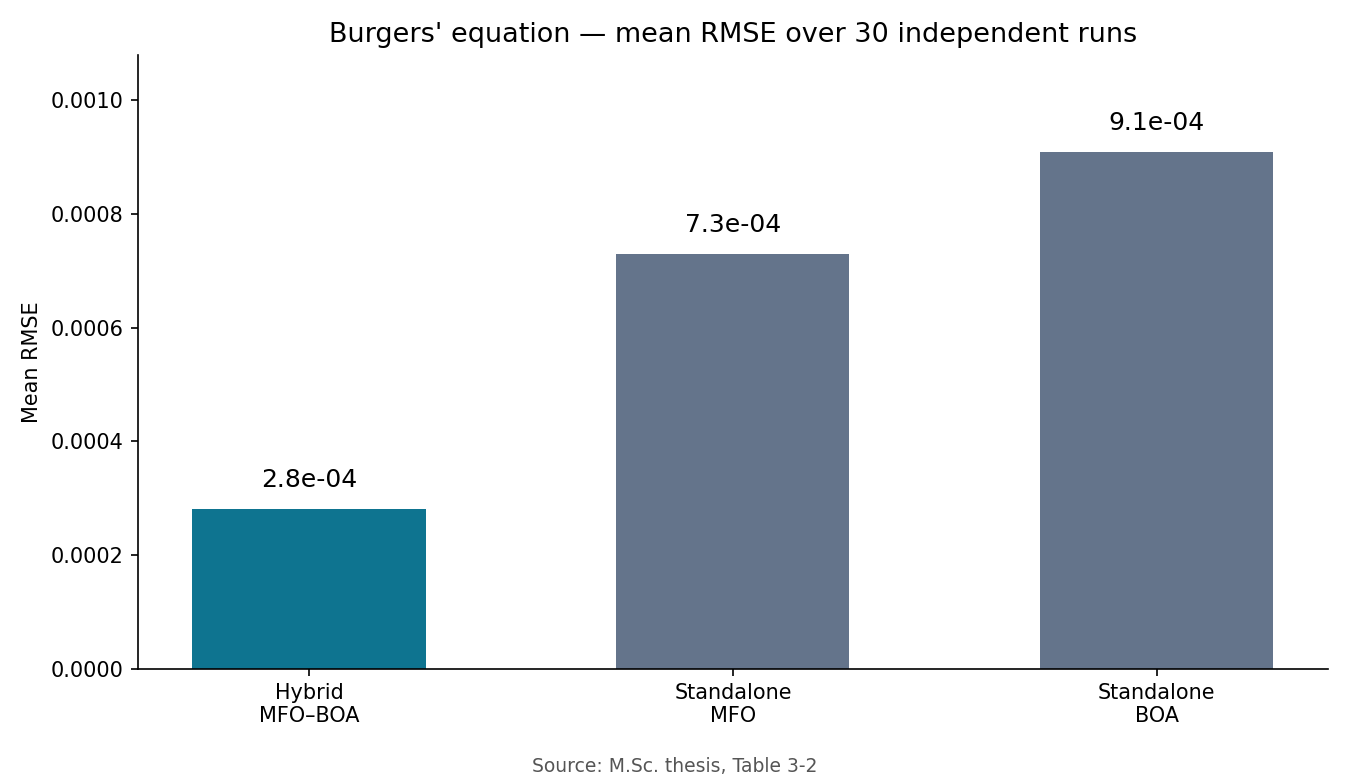
Bar chart: mean RMSE on Burgers' equation over 30 independent runs — Hybrid MFO–BOA 2.8e-04, standalone MFO 7.3e-04, standalone BOA 9.1e-04
Burgers’ equation — mean RMSE over 30 independent runs (M.Sc. thesis, Table 3-2).

Companion paper: MFO–BOA article, Submitted Oct 2026 (see Publications).

  • Python
  • NumPy
  • SciPy
  • B-spline collocation
  • Metaheuristics

Work in progress — dataset + model

Persian Lip-Reading (LRW-Persian)

Persian visual speech recognition evaluated on the LRW-Persian benchmark. Developing deep neural architectures for word-level Persian lip-reading alongside a public dataset release.

Best run achieves 35.31% TEST Top-1 accuracy (compared to the reference paper’s 41.09% on its own test split); run 8 completed at 34.80% TEST Top-1 and its session cannot be resumed — a new run must start from epoch 0 once GPU compute is available.

Companion dataset: Public release on Hugging Face; model code in preparation.

Education

M.Sc. in Soft Computing & Artificial Intelligence

Damghan University · 2026 · GPA 17.49/20, Excellent

Thesis: “Solving Nonlinear Partial Differential Equations Using the Hybrid Moth-Flame and Butterfly Metaheuristic Algorithm and Its Applications in Engineering Problems.”

Supervisor: Dr. Sajjad Rahmani · Co-supervisor: Dr. Reza Pourgholi · Advisor: Dr. Saedeh Foadian

B.Sc. in Computer Science

Birjand University of Technology · 2019–2023

Harvard CS50W — Web Programming with Python and JavaScript

In progress — Mail, Network, Wiki, Commerce and Capstone passed; Search: gradebook review pending

Teaching

Teaching Assistant — Fundamentals of Computation Theory

Damghan University · Sep 2024 – Jan 2025

Skills

Scientific ML & numerical methods

  • Physics-informed neural networks (PINNs)
  • PDE solvers & B-spline collocation
  • Stiff reaction–diffusion systems

Optimization & AI

  • Hybrid metaheuristics (MFO–BOA)
  • Soft computing
  • Deep learning

Languages & libraries

  • Python, NumPy, SciPy, pandas, Matplotlib
  • Git / GitHub, LaTeX, SQL

Certifications & memberships

Harvard CS50
CS50 AI (certificate 3d3cc221-cb86-4d7d-b508-361740a15edf), CS50x, CS50P, CS50 SQL (certificate 59623581-b482-4d07-9567-03017a0adef8), CS50 Cybersecurity (certificate bfb9b272-e544-4901-883d-a7e6176d3050 · 27 Oct 2026)
Hugging Face
Agents Course (Certificate of Excellence · 5 Nov 2026), Fundamentals (Oct 2026)
Kaggle
6 certificates, including Intro to Deep Learning
DataCamp
Intro to Deep Learning with PyTorch · Certificate #50,855,536
DataCamp — Skill Assessment
AI Fundamentals: 189/200 (99th percentile) — a score, not a certificate
IAENG
Member #588946 — Societies of Artificial Intelligence and Computer Science, since Nov 2026

Contact

The best way to reach me is by email. I am open to research collaborations.

reza.abiz80 [at] gmail.com